Toy hauler guides · 8 models · 2,380 to 5,542 lb
Lightweight Toy Haulers
A small toy hauler lets you bring the bikes without buying a bigger truck. We compared eight 2026 models, from 16-footers an SUV can pull to 24-footers built for a half-ton, using the maker’s own weights, and added a calculator to check them against your tow vehicle.
Models compared
8
All with a rear ramp door
Lightest
2,380 lb
Sun Lite 14TH, dry
Lowest hitch
310 lb
Go Lite Boulderback 14
Longest cargo area
15′ 2″
Grey Wolf 18RR
Specs checked November 3, 2026 · By RV-Roundup

Photo: Sarah Denos, BLM California, public domain, via Wikimedia Commons
Lightest on the list
At a glance
Six picks by the way you camp
Short on time? Start with the pick that matches your tow vehicle and your toys. Each one links to its full specs below.
Lowest hitch weight
Go Lite Boulderback 14
Only 310 lb on the ball, the easiest here on your payload.
All-aluminum frame
inTech Flyer Discover
A welded aluminum cage at 2,440 lb dry, with 2,760 lb of capacity.
The short answer
The lightest toy haulers sold new for 2026 weigh about 2,400 to 3,000 lb dry: the Sun Lite 14TH, inTech Flyer Discover, Go Lite Boulderback 14 and Coleman 13T. Many midsize trucks and capable SUVs can pull them, but their cargo capacity is small, often 1,400 to 2,000 lb. If you carry a side-by-side or several big bikes, step up to a 22 to 24-foot model such as the Grey Wolf 18RR or Salem FSX 189RTK, and check it against a properly equipped half-ton. Whatever you choose, shop by the trailer’s GVWR and your vehicle’s payload, not the dry weight, and run the tow check before you visit a dealer.
Read the sticker first
What “lightweight” really means
There is no official weight class for a lightweight toy hauler. Makers and dealers use the word for bumper-pull models that most half-ton trucks, and some SUVs, can tow. Six numbers, three on the trailer and three on your tow vehicle, tell you whether one is light enough for you.
Dry / UVW
Dry weight (unloaded vehicle weight)
What the trailer weighs as built at the factory, with no water, cargo, toys or dealer add-ons. Makers define it slightly differently (Forest River’s UVW includes propane, for example), and options add weight. It is the number in the ads, and one you will never tow at.
GVWR
Gross vehicle weight rating
The most the trailer is allowed to weigh fully loaded, set by the maker and printed on a sticker by the door. Plan your towing around this number, not the dry weight.
CCC
Cargo carrying capacity
How much you can add before you hit the GVWR: water, propane, batteries, food, gear and every toy in the garage. On a small toy hauler this is often less than a big UTV weighs.
CCC = GVWR − dry weight
Hitch
Hitch (tongue) weight
The share of the trailer’s weight pressing down on your hitch ball. Spec sheets list it dry. Toys loaded behind the axle can lighten the tongue too much and cause sway, so load heavy items just ahead of the axle.
Aim for 10–15% of loaded trailer weight
Tow rating
Your vehicle’s towing capacity
The heaviest trailer your truck or SUV can pull, from the owner’s manual or the maker’s trailering guide for your exact engine, axle ratio and package. Many RVers keep the loaded trailer at or under 80% of it.
Loaded trailer ≤ 80% of tow rating
Payload
Your vehicle’s payload
How much the tow vehicle itself can carry: passengers, cargo, the hitch and the trailer’s tongue weight. It is on the yellow tire and loading sticker on the driver’s door, and it runs out before towing capacity on most half-tons.
Tongue + people + cargo ≤ payload
Side by side
8 lightweight toy haulers compared
The chart shows how much each one weighs empty and how heavy it is allowed to get. The table adds the numbers that matter at the hitch and in the garage.
Dry weight vs. fully loaded (GVWR)
Lightest first. The dark bar is the trailer empty; the light bar is the most it may weigh loaded.
- Dry weight
- GVWR (max loaded)
- 5,000 lb
Manufacturer figures for base floorplans, checked November 3, 2026. Options, batteries and solar add weight; the real number is on the yellow sticker on the trailer.
| Model | Dry weight | GVWR | Cargo capacity | Hitch weight | Length | Garage / cargo area | Sleeps | Best for |
|---|---|---|---|---|---|---|---|---|
| Sun Lite 14TH | 2,380 lb | 3,820 lb | 1,440 lb | 320 lb | 16′ 2″ | 10′ 11″ cargo length, 6′ 9″ wide | 2 | Couples with one or two bikes |
| Flyer Discover | 2,440 lb | 5,200 lb | 2,760 lb | 520 lb | 18′ 0″ | Open floor; 6′ 2″ × 6′ 7″ ramp opening | 2 | All-aluminum build, e-bikes or one quad |
| Boulderback 14 | 2,560 lb | 4,000 lb | 1,440 lb | 310 lb | 16′ 2″ | About 8′ | 3–4 | Smallest tow vehicles |
| Coleman 13T | 2,940 lb | 4,880 lb | 1,940 lb | 480 lb | 15′ 11″ | Murphy-bed garage (length not published) | 4 | Families of four on a budget |
| Flyer Forge | 3,845 lb | 7,000 lb | up to 3,155 lb | 680 lb | 22′ 4″ | 10′ 11″ | 3–4 | Two riders and a week of gear |
| Salem FSX 189RTK | 4,513 lb | 9,495 lb | 4,982 lb | 695 lb | 23′ 3″ | Not published; tall garage (see text) | See floorplan | Heavy toys, if your truck can carry the GVWR |
| Grey Wolf 18RR | 5,008 lb | 7,670 lb | 2,662 lb | 670 lb | 24′ 1″ | Up to 15′ 2″ cargo space | 4 | Long toys and half-ton trucks |
| Momentum MAV 17MAV | 5,542 lb | 9,950 lb | 4,408 lb | 873 lb | 22′ 11″ | 11′ 6″, no wheel wells | 2 | Premium build, off-grid weekends |
The models
8 lightweight toy haulers worth a look
Ordered from lightest to heaviest. Every number comes from the maker’s own spec page for the base floorplan; a dealer’s unit with options will weigh more. We have not been paid by any of these brands.
Lightest on this list
Sunset Park Sun Lite 14TH
2026 model year · Sunset Park specs as published by its dealers · checked November 3, 2026
- Dry2,380 lb
- GVWR3,820 lb
- Hitch320 lb
- Length16′ 2″
- Cargo area10′ 11″
The lightest hard-sided toy hauler we found with a full rear ramp. At 16 feet it is barely longer than a utility trailer, yet the cargo area runs almost 11 feet and is close to 7 feet wide, enough for two dirt bikes or a pair of e-bikes and a kayak. A wet bath, a two-burner cooktop and a rear bed make it a real camper once the toys are unloaded.
Best for: midsize trucks and capable SUVs, and riders who camp as a couple.
What we like
- Lowest dry weight here, with a 320 lb hitch
- Long cargo area for a 16-foot trailer
- Wet bath and kitchen in a tiny footprint
Keep in mind
- Only 1,440 lb of cargo capacity: two bikes, water and gear use it up fast
- Sleeps two
- Compact wet bath, no separate shower
All-aluminum frame
inTech Flyer Discover
2026 model year · from $30,521 (inTech) · dry weight 2,440–2,760 lb depending on options
- Dry2,440 lb
- GVWR5,200 lb
- Hitch520 lb
- Length18′
- Ramp opening6′ 2″ × 6′ 7″
inTech builds the Flyer on a fully welded aluminum cage, which is how an 18-foot toy hauler stays this light while still offering more than 2,700 lb of carrying capacity. The whole floor is open garage space; a tip-out bed folds out of the wall at night, so you are not sleeping above the toys. It is the most “built” trailer at this weight.
Best for: riders who want a premium, rust-free shell and travel light on water.
What we like
- Welded aluminum cage frame
- Big carrying capacity for its weight
- Tip-out bed keeps the floor clear
Keep in mind
- 8.5-gallon fresh tank in the base build
- Sleeps two
- Options can add about 300 lb, and cost
Lowest hitch weight
Wayfinder Go Lite Boulderback 14
2026 model year · specs from Wayfinder’s dealer Bish’s RV · checked November 3, 2026
- Dry2,560 lb
- GVWR4,000 lb
- Hitch310 lb
- Length16′ 2″
- Fresh water36 gal
With only 310 lb on the ball and a 4,000 lb GVWR, the Boulderback is the easiest trailer here on a tow vehicle’s payload. It still fits a wet bath, a farmhouse sink and a 47 by 81-inch pop-out tent bed, and its 36-gallon fresh tank is the biggest among the 16-footers. The garage is the shortest on the list, so measure your toys first.
Best for: midsize trucks, SUVs and families with small bikes, kayaks or a go-kart.
What we like
- Lowest hitch weight on this list
- 36-gallon fresh tank
- Pop-out tent bed adds sleeping space
Keep in mind
- Shortest garage here, about 8 feet
- 1,440 lb of cargo capacity
- Sold mainly through Bish’s RV stores
Best for a family of four
Keystone Coleman 13T
2026 model year · Keystone specification as published by its dealers · checked November 3, 2026
- Dry2,940 lb
- GVWR4,880 lb
- Hitch480 lb
- Length15′ 11″
- Sleeps4
The Coleman 13T is the shortest trailer here and still sleeps four, thanks to a Murphy bed that folds up over the garage and a pop-out tent bed. Keystone fits a roof air conditioner, a 20,000 BTU furnace and a tankless water heater, so it works as a three-season camper when the bikes stay home. Nearly 2,000 lb of cargo capacity is generous at this size.
Best for: families who want one small trailer for bikes in summer and camping year-round.
What we like
- Sleeps four in under 16 feet
- Almost 2,000 lb of cargo capacity
- AC, furnace and tankless water heater
Keep in mind
- Murphy bed must be up to load toys
- 21-gallon fresh tank
- Some dealer units list 3,005 lb dry with options
Most capable aluminum build
inTech Flyer Forge
2026 model year · from $41,300 (inTech) · dry weight 3,845–4,300 lb depending on options
- Dry3,845 lb
- GVWR7,000 lb
- Hitch680 lb
- Length22′ 4″
- Garage10′ 11″
The Forge is the Flyer Discover stretched to 22 feet, adding a wet bath and an aluminum walk-on roof while keeping the welded aluminum cage. Nine tie-down rings and a garage just under 11 feet handle two dirt bikes or a small UTV, and more than 3,000 lb of carrying capacity means you can bring water, gear and the toys without doing sums at every fuel stop.
Best for: couples or small families who ride most weekends and want a trailer that lasts.
What we like
- Aluminum cage frame and walk-on roof
- Over 3,000 lb of carrying capacity
- Wet bath and a real kitchen
Keep in mind
- Costs more than steel-framed trailers of a similar size
- Options push dry weight toward 4,300 lb
- 28-gallon fresh tank
Most cargo capacity
Forest River Salem FSX 189RTK
2026 model year · Forest River spec sheet · checked November 3, 2026
- UVW4,513 lb
- GVWR9,495 lb
- Hitch695 lb
- Length23′ 3″
- CCC4,982 lb
The 189RTK weighs about as much as a mid-size travel trailer empty, but Forest River rates it to carry almost 5,000 lb, far more than most rigs this size. That makes it the one to look at for a heavy side-by-side. Forest River says its FSX toy haulers have up to 84 inches of garage height, a ramp approach of about 16 degrees for low toys and 1,500 lb tie-downs; check the exact unit with your dealer.
Best for: owners of a half-ton or larger truck who need to carry a UTV.
What we like
- Nearly 5,000 lb of cargo capacity
- 54-gallon fresh tank
- Tall garage and gentle ramp angle on FSX toy haulers
Keep in mind
- Loaded to GVWR it needs a truck rated for about 11,900 lb under the 80% rule
- 11′ 3″ tall
- Garage length not listed on the spec sheet
Longest cargo area
Forest River Cherokee Grey Wolf 18RR
2026 model year · Forest River spec sheet · checked November 3, 2026
- UVW5,008 lb
- GVWR7,670 lb
- Hitch670 lb
- Length24′ 1″
- Cargo space15′ 2″
The Grey Wolf 18RR gives you up to 15 feet 2 inches of cargo space without a slide-out, the longest here, and a front queen bedroom you never have to fold away. Forest River’s Adventure Package (off-road tires, a lifted frame and diamond-plate skirting) is standard on the ramp models, and the 52-gallon fresh tank suits dry camping.
Best for: half-ton owners hauling a longer UTV, a golf cart or three bikes.
What we like
- Longest cargo area on this list
- Separate front bedroom
- Off-road tires and lifted frame standard
Keep in mind
- Heaviest dry weight here apart from the MAV
- A GVWR of 7,670 lb needs about 9,600 lb of towing capacity under the 80% rule
- Black Label 18RRBL version weighs 5,247 lb
Best premium build
Grand Design Momentum MAV 17MAV
2026 model year · Grand Design specs as published by its dealers · checked November 3, 2026
- Dry5,542 lb
- GVWR9,950 lb
- Hitch873 lb
- Length22′ 11″
- Garage11′ 6″
The smallest Momentum MAV brings Grand Design’s full toy hauler kit to a 23-foot trailer: an 11-foot 6-inch garage with no wheel wells, 2,500 lb tie-downs anchored into the chassis, a 24-inch dovetail ramp, a 90-gallon fresh tank and solar. It is the heaviest trailer here and the hitch weight is close to 900 lb, so check your truck’s payload before you fall for it.
Best for: couples with a capable half-ton or a three-quarter-ton who camp off the grid.
What we like
- Garage with no wheel wells and 2,500 lb tie-downs
- 90-gallon fresh tank and solar
- Heated, enclosed underbelly
Keep in mind
- Heaviest hitch weight on this list, 873 lb
- Sleeps two
- GVWR near 10,000 lb rules out many half-tons
Interactive
Can your truck or SUV tow it?
Pick a toy hauler and enter three numbers from your vehicle. The check runs the same math a careful dealer would: the 80% towing rule, tongue weight against payload, and the trailer’s own limit.
Pick a toy hauler to see how it matches your tow vehicle.
An estimate, not a guarantee. It assumes a bumper-pull trailer with 13% of its loaded weight on the hitch. Weigh the loaded rig at a CAT scale and follow your vehicle maker’s limits, including GCWR and rear-axle rating.
Watch a walkthrough
See a small toy hauler up close
Grand Design’s own tour of the 17MAV shows what a 23-foot toy hauler fits in: the garage, the bed system, the ramp and the tanks. Use it as a checklist when you tour any trailer on this list.
Video: Grand Design RV on YouTube. Plays from YouTube when you press play.
What to watch for
- How long the garage is with the bed or sofas folded down, not just up
- Where the tie-downs sit and whether they bolt into the frame
- The ramp angle, and whether a low-slung toy will scrape
- Where the fresh tank sits: ahead of the axle adds tongue weight, behind it takes weight away
- Ventilation and a separate garage door seal if you carry gas-powered toys
Step by step
How to choose a lightweight toy hauler
Seven checks, in the order that saves the most time. Do the first two at home before you visit a dealer.
- Write down your three vehicle numbers. Towing capacity, payload (door-jamb sticker) and GCWR, the most your truck and trailer may weigh together. Use the figures for your exact configuration, not the brochure maximum.
- Weigh your toys. Look up the curb weight of every bike, quad or UTV you plan to carry, then add fuel, ramps, tie-downs and riding gear. That total has to fit inside the trailer’s cargo capacity along with water and camping gear.
- Measure the toys, then the garage. Check the garage length with the ramp up, the ramp-door width and height, and the floor width between wheel wells. A UTV that fits on paper may not clear the door or the bed above it.
- Shop by GVWR, not dry weight. Divide the trailer’s GVWR by your towing capacity. Under 80% leaves room for hills, wind and braking; over 100% is a non-starter whatever the salesperson says.
- Check tie-downs, floor and ramp ratings. Look for D-rings bolted through to the frame, a sealed or rubber-coated floor, and a ramp door rated for the weight you will drive up it. Fuel stations and vented garages matter if you carry gas toys.
- Decide where you will camp. Off-grid riding areas call for bigger tanks, solar and more ground clearance. Hookup sites at RV parks let you get by with less, which keeps the weight down.
- Weigh the loaded rig before the first long trip. A CAT scale at a truck stop gives you axle, truck and trailer weights for a small fee. It is the only way to know your real tongue weight and whether you are inside every rating.
The number that catches people out
It is usually payload, not towing capacity. A half-ton rated to tow 9,000 lb or more often has well under 2,000 lb of payload, and the trailer’s tongue weight, your passengers, the hitch and everything in the bed all come out of that. Check the yellow tire and loading sticker on the driver’s door before you shop.
Keep exploring
More from RV-Roundup
Places to ride, places to park the rig, and gear for the garage.

RV Parks in the Yuma Area
The closest RV parks with full hookups to the Imperial Sand Dunes, about 20 miles west.
Best Toy Hauler Travel Trailers
Need a 13 to 15-foot garage? Eight full-size bumper-pull toy haulers and the truck each needs.
Best RV Camping Tools
Tie-downs, wheel chocks and the tools worth carrying when the garage is full of toys.
Helpful answers
Lightweight toy hauler questions, answered
What buyers ask most before towing one home.
Start here
Check the payload first
Find the yellow tire and loading sticker on your driver’s door, then run the tow check. It takes a minute and rules out the trailers your vehicle can’t carry.
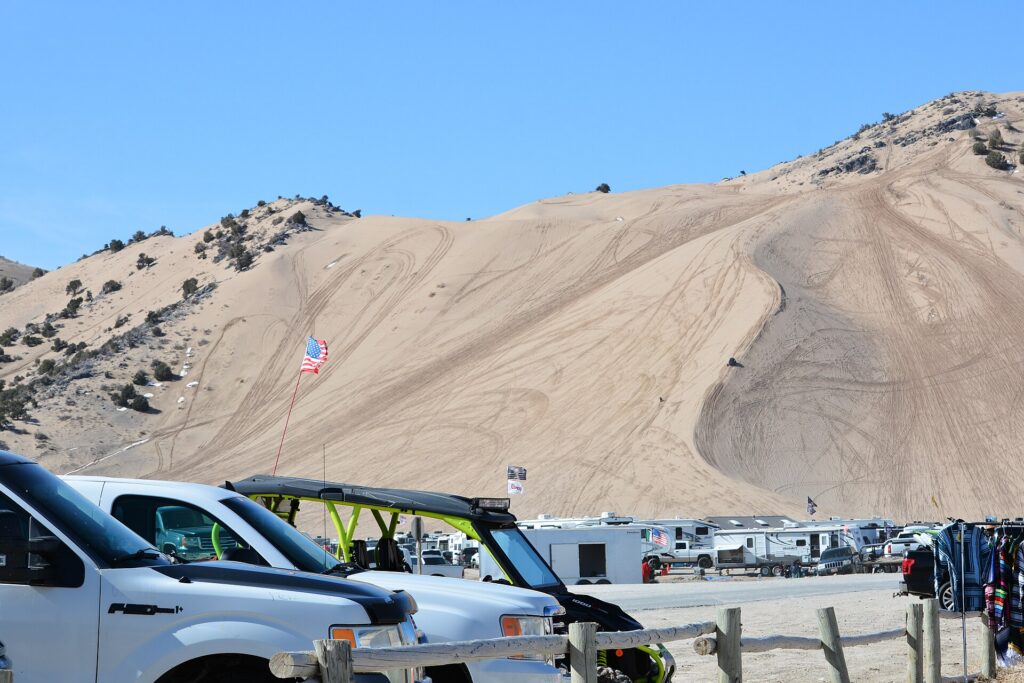
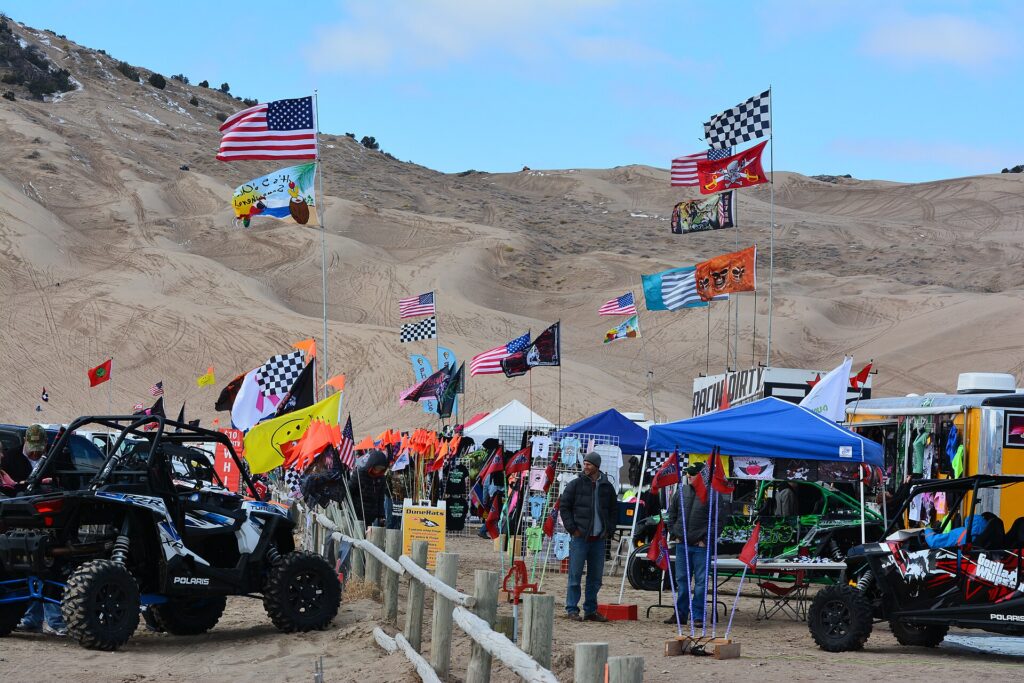
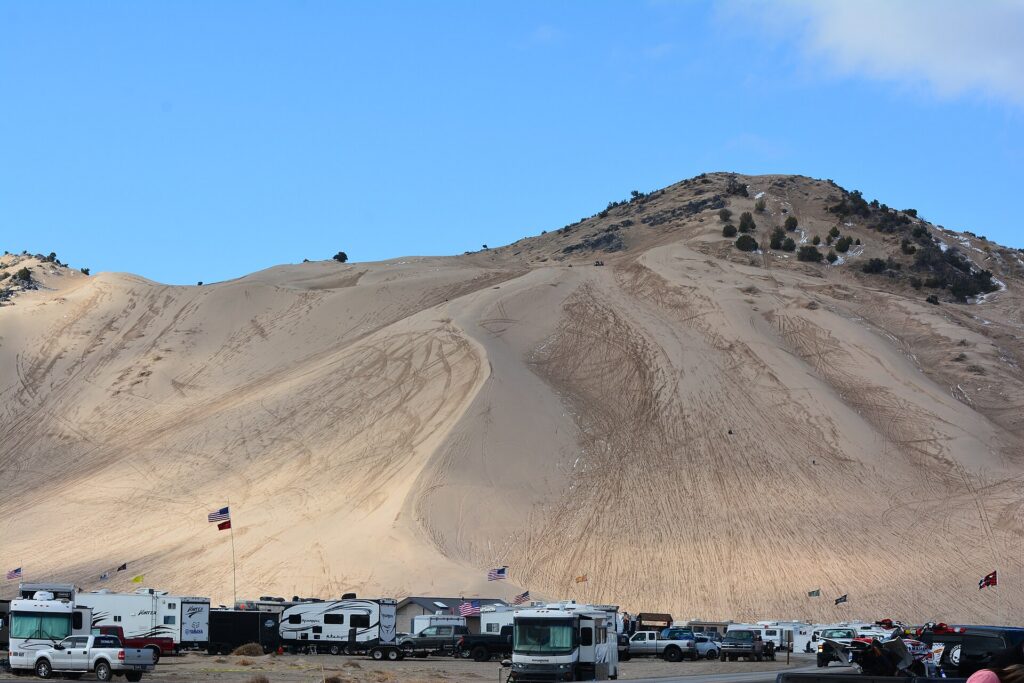
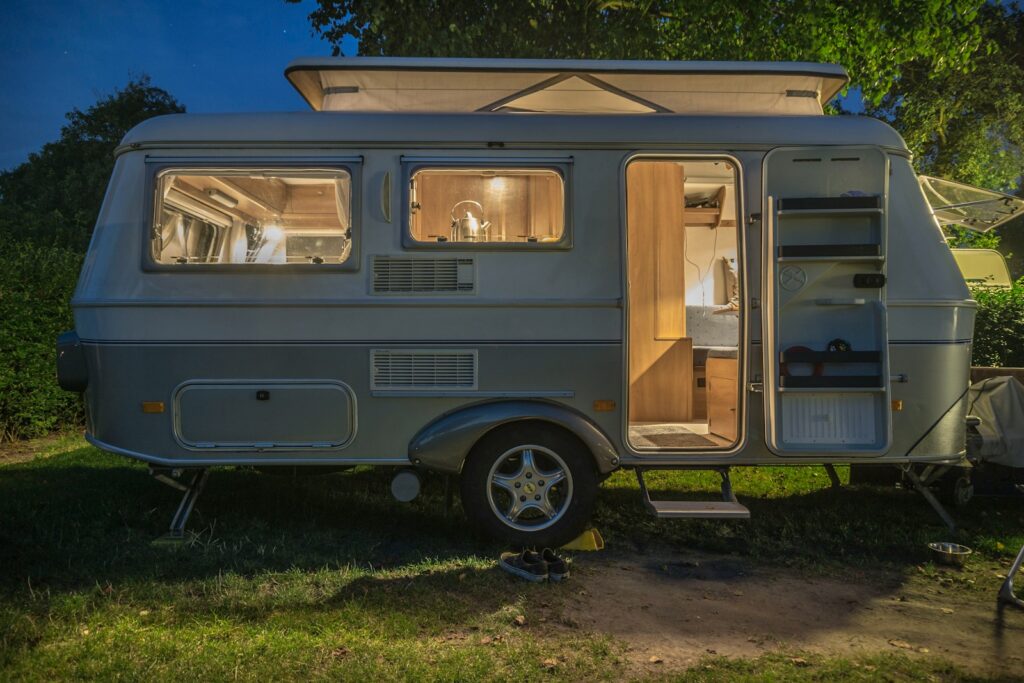
Thank you to the people behind these photos. Hero photo: ISDRA camping by Sarah Denos, BLM California (public domain), via Wikimedia Commons. Section photos: Base camping area at Sand Mountain by Jeremy T. Dyer and Little Sahara Easter Weekend by Hannah Cowan, BLM Utah (public domain), via Wikimedia Commons; resized. Card photos: Yuma and Quartzsite photos as credited on those guides; camper at dusk by Stephan Widua on Unsplash. The trailer drawings are RV-Roundup illustrations, not product photos. Brand and model names are trademarks of their owners.
How we made this guide
No manufacturer or dealer paid to be on this page, and the “See it on the maker’s site” buttons are plain links, not affiliate links. We chose models that are sold new for the current model year, weigh under about 5,500 lb dry, and have a rear ramp door. Weights are the maker’s published figures for the base floorplan; we have not weighed these trailers ourselves.
Sources we checked on November 3, 2026: manufacturer spec sheets from Forest River (Salem FSX 189RTK) and Forest River (Cherokee Grey Wolf 18RR); inTech (Flyer lengths and starting prices); dealer listings of maker specifications for inTech, Keystone, Grand Design, Wayfinder and Sunset Park models (RVUSA, Bish’s RV, Camping World, Western RV Country, Campers Inn RV); towing guidance from TowingSpecs (tongue weight), RVBlogger (the 80% rule) and Camping World (half-ton towable).
Use your judgment. Towing limits come from your vehicle maker, not from a trailer brochure or this page. Weigh your loaded rig, use a properly rated hitch and brake controller, and follow both manufacturers’ instructions. Specifications, floorplans and prices change during the model year. This page is general information, not professional advice; RV-Roundup is not responsible for errors, omissions or changes made after publication.