RV Tips · Holding tanks · 8 places to look
Easily Find RV Dump Locations Near Me
Where to empty your tanks on the road: the apps that still work with no signal, which travel centers, rest areas and parks let passing RVers dump, what it costs, and how to do it cleanly in about ten minutes.
Typical fee
$5–$10
Travel centers and parks
Often free
Rest areas
In states that build them
Offline finder
$0.99
RV Dump Stations app
Dump order
Black, then gray
Every single time
Fees, apps and rules checked November 2, 2026 · By RV-Roundup
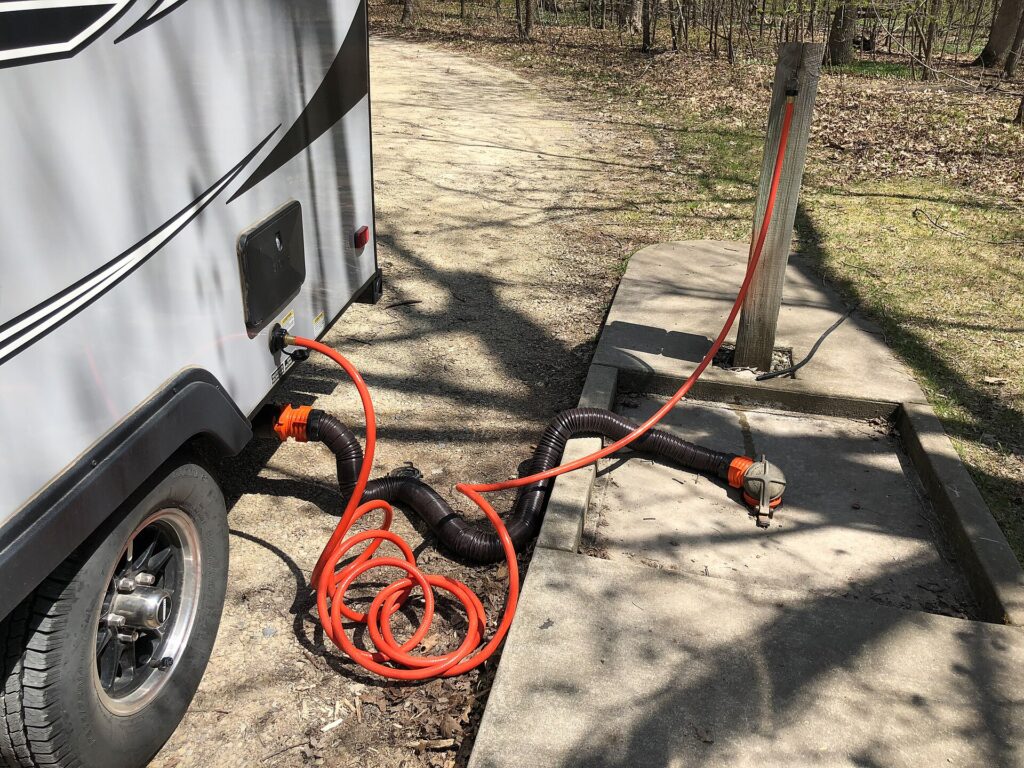
A travel trailer hooked up at a campground dump station
Photo: Tony Webster on Wikimedia Commons (CC BY 2.0)
Short on time
Find a dump station in the next ten minutes
Three moves cover almost every situation. Start with the one that matches where you are right now.
No cell signal
Open an offline dump app
RV Dump Stations keeps its 7,100-plus locations on your iPhone, so the map still loads in a dead zone.
On the interstate
Head for a travel center
Many Pilot, Flying J and Love’s stops have an RV dump near the fuel islands, usually for about $10.
Near a park or town
Try a public dump station
State parks, national park campgrounds, rest areas and city treatment plants often let passing RVers dump, free or for a small fee.
The short answer
The quickest way to find an RV dump station near you is a dump-station app that works offline, such as RV Dump Stations ($0.99 on iPhone), backed up by the nearest Pilot Flying J or Love’s travel center, where a dump typically costs about $10. State and national parks, some highway rest areas and city wastewater plants also take passing RVers, sometimes free and sometimes for $5 to $10. Check recent reviews or call first: dump stations close for repairs, winter and misuse more often than any list admits.
Where to look
Eight places that usually have an RV dump station
Some are free, most charge a small fee, and any of them can be closed the day you arrive. Here is what to expect at each.
Travel centers
Pilot, Flying J and Love’s put RV dumps at many of their stops, often beside the propane tank or the car pumps. You pay inside for a code or key. Pilot Flying J takes money off the fee for Good Sam members and RV Plus card holders.
Typical: about $10 · Some have no fresh water
Highway rest areas
A few states build dump stations into rest areas. Washington’s DOT lists every rest area’s RV dump as open or closed, and 12 were open on its I-5, I-82 and I-90 list when we checked.
Typical: free · Some close in winter
State parks
Many state parks let non-campers dump for a fee. California State Parks charge $10 at most dump stations, Oregon added a $10 fee at 19 stations on March 30, 2026, and New Mexico charges non-campers $10.
Typical: $5–$10 · Often included for campers
National park campgrounds
Federal campgrounds with a dump station often sell single dumps to passing RVers. Zion and Bryce Canyon charge non-campers $5 through Recreation.gov, and campers with a reservation pay nothing extra.
Typical: $5 · Pay online or at the kiosk
Private campgrounds
Most private RV parks keep their dump for guests, but plenty sell a dump-only visit, typically $10 to $20. Call first and ask where the dump is, what it costs and whether your rig will fit.
Typical: $10–$20 · Call ahead
Stores and RV dealers
Some Cabela’s stores have a dump that costs $5 or is free with a purchase, and some Camping World stores, RV dealers and storage lots have one too. Many stores have removed theirs, so confirm before you drive over.
Typical: free–$5 · Check it still exists
City dumps and treatment plants
Towns, fairgrounds and wastewater plants run some of the cheapest dumps around. North Bend, Oregon, for example, keeps a self-serve RV dump open year-round at its treatment plant.
Typical: free–$10 · Often daytime hours
Public land
BLM long-term visitor areas and some Forest Service and BLM campgrounds have dump stations for their campers. Arizona’s La Posa LTVA near Quartzsite has two.
Typical: included with your permit
Apps and websites
The best apps and sites for finding RV dump stations
Use one as your main finder and a second to double-check. Listings are crowd-sourced, and a station that worked last month can be closed today.
iPhone, iPadWorks offline
RV Dump Stations
The one to install first. Its database of more than 7,100 dump stations in the US and Canada ships inside the app, so locations show up with no signal, and a filter can hide everything but the free ones. Listings come from users, and the developer itself recommends calling a station before you rely on it.
- Locations visible with no signal
- Filter to free dump stations only
- Apple devices only
iPhone, iPadOffline city lookup
RV Dumps by Allstays
Pulls every place with a dump station out of the large Allstays Camp & RV database, from rest areas and truck stops to wastewater treatment plants. Maps need a connection, but a manual city lookup works offline.
- Includes treatment plants and stores
- Closed stations are pruned regularly
- Maps need cell service
Web, iOS, AndroidFree map search
Campendium
Campendium’s map has a dump-station layer you can search free, and member reviews often note the price, whether there is fresh water and the longest rig that fit.
- Reviews list price and water
- Longest rig reported on many listings
- Pro features cost extra
WebFree, ad-supported
RVingLife
The long-running Sanidumps directory carries on as RVingLife, with state and city lists of dump stations and their fees. Washington alone lists 282 stations across 156 cities.
- Browse by state and city
- Fees and notes on many listings
- Best for planning at home
iOS, Android, WebOffline on paid tiers
iOverlander
Community-built and global, with water and dump stations listed alongside places to camp. It is the one to carry if you are heading into Canada, Mexico or farther.
- Covers far beyond the US
- Water and dump stations together
- Offline maps on the paid tiers
iOS, AndroidNeeds signal
Travel center apps
Both chains’ free apps show which stops have an RV dump, propane and RV-friendly lanes, which saves you pulling into a stop that cannot take your rig.
- Store amenities listed per stop
- Handy for planning fuel and dump together
- Everything needs a connection
Before you detour across town
Dump stations close without notice. Allstays says it removes several closed stations every day, and Washington’s own rest-area list showed four RV dumps closed when we checked. Read the newest reviews or call ahead, especially in winter. For the rest of your phone, see our best RV apps guide.
Side by side
What it costs to use an RV dump station
Prices from official pages and recent RVer reports, checked November 2, 2026. Swipe sideways on a phone.
| Where | Typical price | How you pay | Watch for |
|---|---|---|---|
| Pilot and Flying J | About $10; less with Good Sam or the RV Plus card | Pay inside for a code | Rinse water is not always drinkable |
| Love’s | About $10 (we saw $15 at one stop) | Pay at the register to unlock it | Many have no fresh water; some tight lanes |
| Highway rest areas (e.g. Washington) | Free | Nothing to pay | Seasonal and maintenance closures |
| California state parks | $10 | Card at the Sani-Star machine | Applies at most state park dump stations |
| Oregon state parks (19 stations) | $10 | QR code at the station, or online | Registered campers pay once per stay |
| National parks (Zion, Bryce Canyon) | $5 for non-campers | Recreation.gov pass | Included with a campsite reservation |
| Private campgrounds | $10–$20 dump-only | At the office | Many are for guests only |
| Cabela’s (where still offered) | $5, or free with a purchase | Card at the machine or code from the cashier | Many stores have removed theirs |
Step by step
How to use an RV dump station
About ten minutes, start to finish, once you have done it twice. Wear gloves and dump black before gray, every time.
- Arrive with tanks at least three-quarters full More liquid carries the solids out and makes clogs less likely. A nearly empty black tank drains poorly.
- Line up on the right side Pull up so your tank outlet sits close to the inlet, and leave room for the rig behind you.
- Gloves on, then check the hose Look for cracks and loose fittings before you need them, and keep both tank valves closed.
- Connect the station end first Seat the elbow or rubber donut firmly in the inlet, then twist the bayonet fitting onto your RV’s outlet.
- Open the black valve slowly Crack it open and watch for leaks before opening it fully. Stay with the hose until it runs empty, then close the valve.
- Then dump the gray tank The soapy gray water rinses black-tank residue out of the hose. Let it drain fully and close the valve.
- Rinse the black tank if you can Use your built-in tank flush or a back-flush fitting with the station’s rinse hose, never your drinking-water hose. Skip it when a line is waiting.
- Drain and disconnect the hose Lift the hose from the RV end so the last of it runs into the inlet, unhook the RV end first and cap the outlet.
- Rinse the hose and the pad Run water through the hose, wash any spills into the drain and stow the sewer hose away from your fresh-water hose.
- Wash up and make a note Bin disposable gloves, wash your hands and jot down the date, so you know roughly when you will need the next stop.
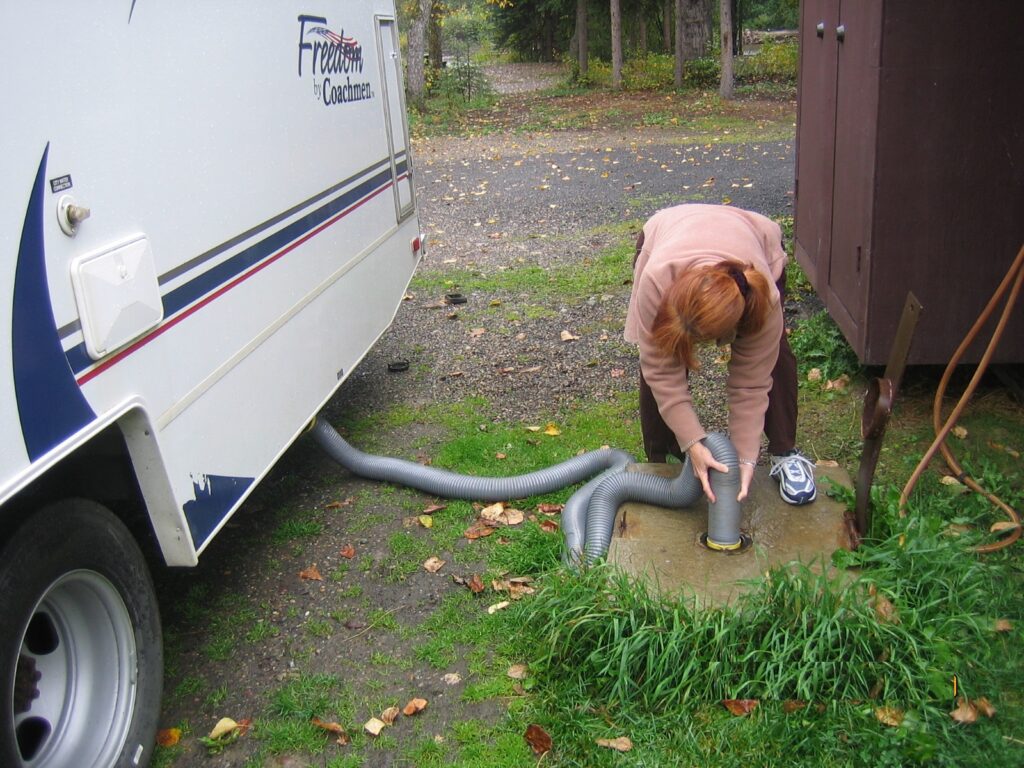
Photo: Mandruss on Wikimedia Commons (CC BY-SA 3.0)
Never fill up from the rinse hose
The hose at a dump station is for rinsing only, even when the water looks clean. Fill your fresh tank from a tap marked as drinking water, with your own drinking-water hose, and keep that hose in a different bin from the sewer gear.
Good manners
Dump station etiquette, and the rules that keep them open
Dump stations disappear when they get abused. These habits keep you welcome and keep the next one open.
- Keep the line moving. If rigs are waiting, dump and go, and save the long tank rinse for a quiet station.
- Only tank water goes in. No trash, wipes, paper towels or pet waste down the inlet.
- Skip formaldehyde tank chemicals. Many dumps drain to septic systems, and formaldehyde kills the bacteria that treat the waste. Use an enzyme or bacteria treatment instead.
- Never dump on the ground. Black water goes only into an approved dump or sewer, and many states treat gray water as sewage too.
- Pay the fee or the honor box. Fees cover the pumping and repairs that keep the station there for the next RVer.
- Leave it cleaner than you found it. Wash spills into the drain, close the inlet lid and take your trash with you.
What about gray water on the ground?
Rules vary by state and by land manager. Arizona treats kitchen sink water as sewage, and Clallam County, Washington, reminds RVers that gray water carries harmful bacteria and belongs in a dump station. Unless a posted rule clearly allows it, treat both tanks the same and take them to a dump.
Dump kit
What to keep in your dump kit
One bin, stored away from your fresh-water gear, makes every stop quicker and cleaner.
- A sewer hose kit with a clear elbow, so you can see when the tank runs clean
- A separate rinse hose in a different color from your drinking-water hose
- Disposable or reusable gloves, plus hand sanitizer or wipes
- A rubber donut or threaded adapter for inlets the elbow does not seal
- Enzyme-based tank treatment instead of formaldehyde products
- A back-flush fitting or tank wand if your RV has no built-in black-tank flush
- A spare outlet cap, because the one on the bumper eventually goes missing
- A trash bag for gloves and wipes when the station has no bin
Keep exploring
More RV guides from RV-Roundup
Apps, memberships and the gear that make life on the road easier.
Best RV Apps for Planning, Traveling & Camping
RV-safe routing, campground finders, fuel apps and the few that still work offline.
Read the guide: Best RV Apps for Planning, Traveling & Camping
Best RV Campground Memberships
Free overnight stays, half-price campgrounds and the passes full-timers swear by.
Best RV Camping Tools
Surge protection, water and sewer gear, tire tools and the fixes that save a trip.
Helpful answers
RV dump station questions, answered
What RVers ask most about finding, paying for and using dump stations.
Our go-to app
Start with RV Dump Stations
More than 7,100 dump stations on your iPhone, visible with no signal, for a one-time $0.99.
Thank you to the people behind these photos. The top photo is by Tony Webster (CC BY 2.0) and the step-by-step photo is by Mandruss (CC BY-SA 3.0), both on Wikimedia Commons (opens in a new tab). Other photos are from RV-Roundup’s library.
How we made this guide
We checked every app, fee and rule on this page against the publisher’s or agency’s own website, the App Store and recent RVer reports on November 2, 2026. No business paid to be included, and none of the links on this page are affiliate links. Dump station fees, hours and availability change often, so confirm with the station before you rely on it.